Buy xbedo.com ?
We are moving the project
xbedo.com .
Are you interested in purchasing the domain
xbedo.com ?
domain@kv-gmbh.de · 0541-91531010
Buy xbedo.com ?
When do I use "del" and when do I use "al"?
"Del" is a contraction of "de" (of, from) and "el" (the), and is used to indicate possession or relationship between two things. For example, "el libro del estudiante" (the student's book). On the other hand, "al" is a contraction of "a" (to, at) and "el" (the), and is used to indicate movement or direction towards a specific place or time. For example, "Voy al supermercado" (I'm going to the supermarket). **
What is the name of this mobile phone song Ai di di di di di di dai? I think it's a Russian song.
The song you are referring to is "Ai, Ai, Ai" by the Russian artist Polina Gagarina. It is a popular Russian pop song that gained international recognition. The catchy melody and upbeat rhythm have made it a favorite for mobile phone ringtones and music downloads. If you enjoy this song, you may also like other hits by Polina Gagarina. **
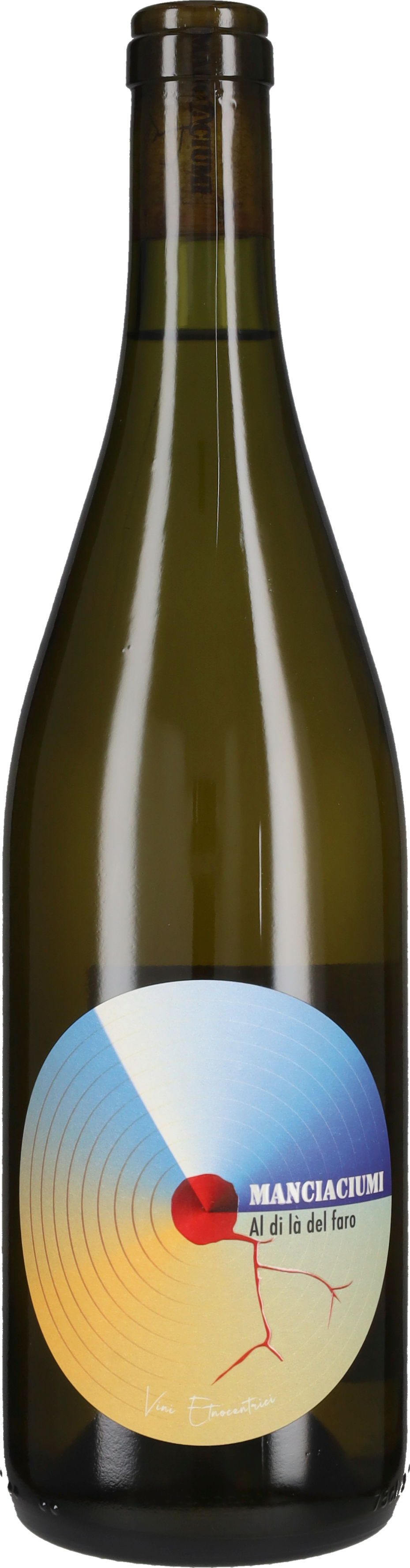
Similar search terms for Al-di-là-del
Top-Angebote
Products related to Al-di-là-del:
-
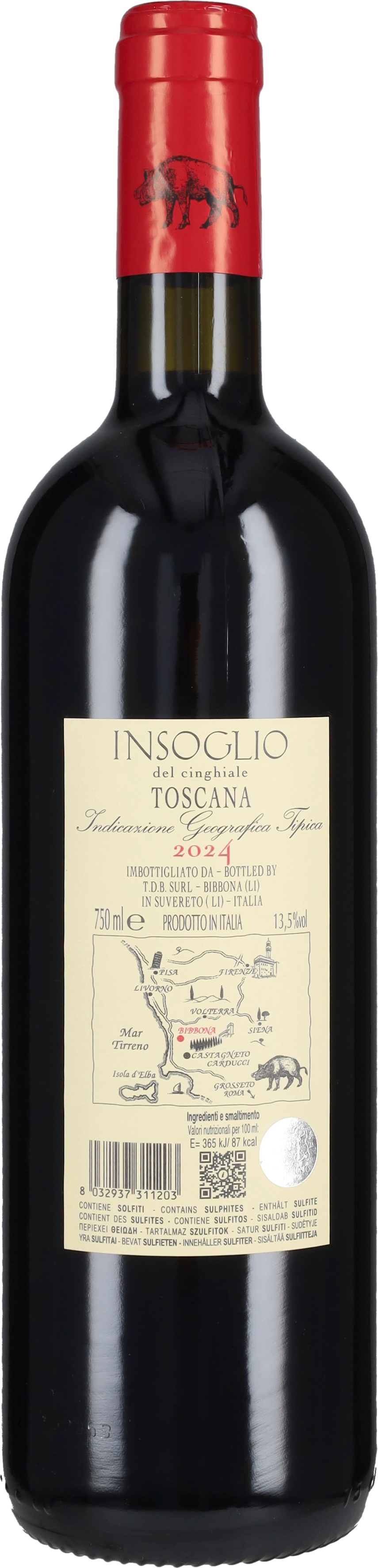
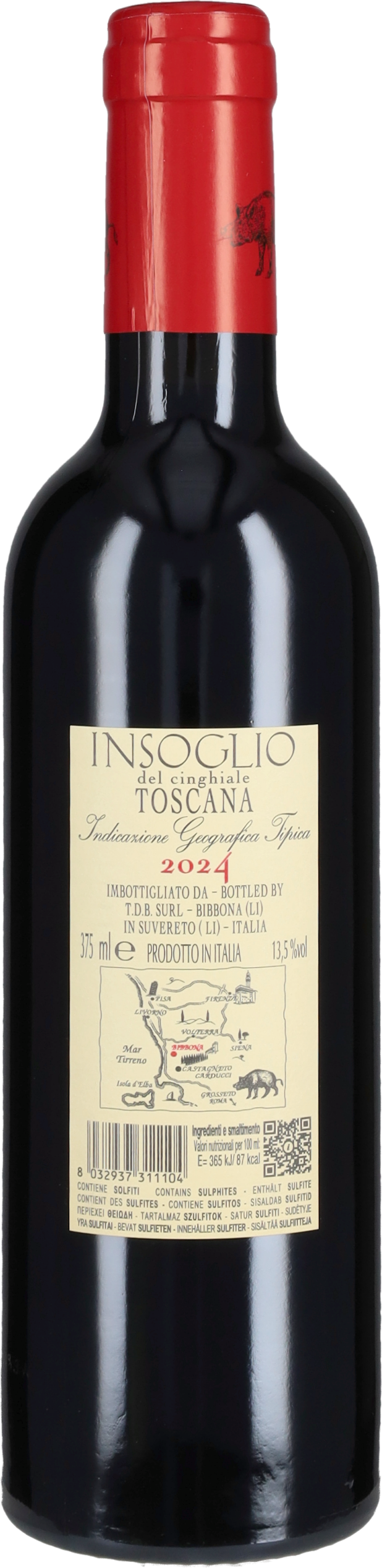
Insoglio del Cinghiale Campo di Sasso - Tenuta di Biserno 2024 - 37.5clThe Tuscan wine Insoglio del Cinghiale Campo di Sasso is the cornerstone of the entire production of Tenuta di Biserno, founded in 2001 by Marquis Lodovico Antinori, who was eager to invest in the terroir of the Upper Maremma. A juicy, ripe label, which originates from a blend of Syrah, Cabernet Franc, Merlot and Petit Verdot, skilfully blended to give a balanced and quality sip, particularly fresh on the palate. The tannins are also striking, finely polished and rounded.This Insoglio del Cinghiale Campo di Sasso is made from a blend of international grape varieties only, varieties which over the last few decades have proved to be perfectly suited to the terroir of the Tuscan Maremma. In addition to the 30% Syrah, there is also Cabernet Franc, Merlot and Petit Verdot, varieties grown by Tenuta di Biserno using the spurred cordon system. Harvesting takes place between the first week of September and the second week of October. After a gentle pressing of the grapes, the must ferments in steel tanks at a controlled temperature for a period of 14 to 21 days. It is then matured for 8 months in new barrels and steel vats.The red wine Insoglio del Cinghiale Campo di Sasso, produced by the Tenuta di Biserno winery, has an intense ruby-red colour. The nose is full-bodied, with notes of red berries alternating with spices and hints of aromatic herbs; on the finish, the aroma is delicate, tending towards balsamic. On the palate, it is medium-bodied and balanced, with an impressive mouthfeel and an excellent vein that refreshes the drink. The best wine in the entire Bibbona range, perfect with succulent game dishes.13,00 £*Shipping: 48,00 £Secure redirect to the provider
-
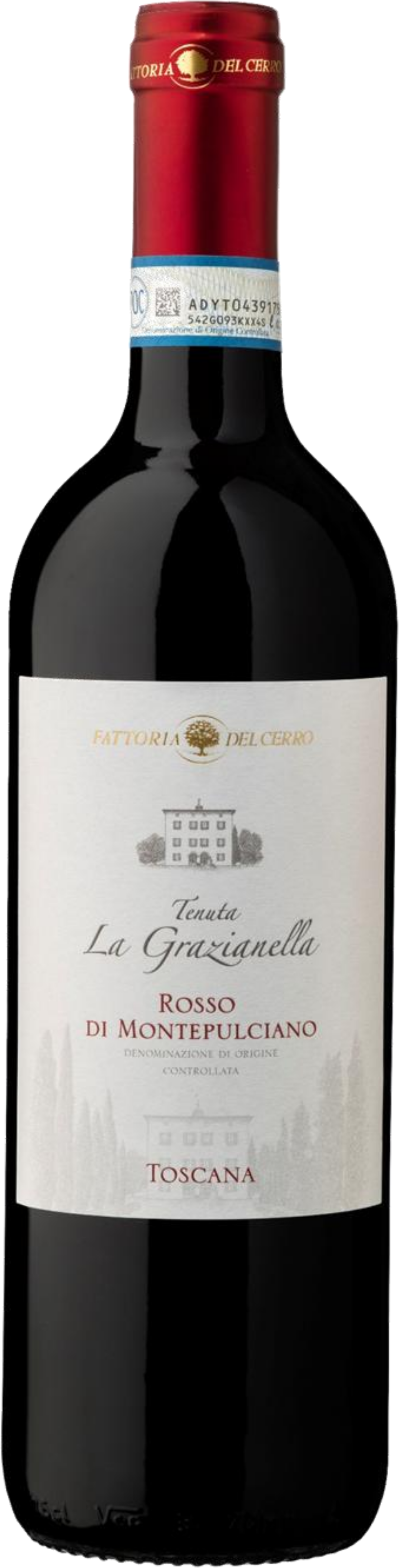
Rosso di Montepulciano Fattoria del Cerro 2024The Rosso di Montepulciano from Tenute del Cerro is a fragrant and fresh wine that expresses all the fruity richness of the Prugnolo Gentile grape. It is the youngest and pleasantly immediate version of the wines produced in the wonderful area of Montepulciano. On the hills surrounding the historic village, the vineyards produce grapes rich in scents and aromas, which we find with extreme varietal fidelity in the glass. A sip of red fruit, cherry, and light spicy nuances. It is a perfect wine to bring to the table to accompany the flavorful first courses of traditional Tuscan cuisine. The Rosso di Montepulciano is produced in one of the numerous estates managed by Tenute del Cerro, an important player in Italian wine, which operates mainly in Tuscany and Umbria. The wines of Montepulciano are produced at Fattoria del Cero, which along with La Poderina in Montalcino, Monterufoli in Chianti, Montecorona between Gubbio, and Colpetrone in Montefalco, constitutes a mosaic of vocated territories, allowing for the cultivation of each grape variety in the historically most vocated area, so that highlight its peculiar characteristics. The wines of Fattoria del Cerro are the result of careful work in the vineyards of the Montepulciano area, followed by a winemaking process carried out with very meticulous protocols. This way, a label is born that manages to authentically express the character of the grapes. The Rosso di Montepulciano from Cerro expresses the truest and sincerest face of Prugnolo Gentile, in its most fragrant and typically varietal version. At the end of the harvest, fermentation takes place in temperature-controlled stainless steel tanks, with skin maceration. The wine presents itself in the glass with a ruby red color and youthful violet hues. On the nose, it expresses a bouquet characterized by delicate scents of violet, aromas of ripe cherry, small red berry fruits, and nuances of aromatic herbs from the Mediterranean scrub. On the palate, it is medium-bodied, with a light tannic texture, a pleasantly juicy and fruity sip. The finish is fresh and has good taste persistence.9,00 £*Shipping: 48,00 £Secure redirect to the provider
-
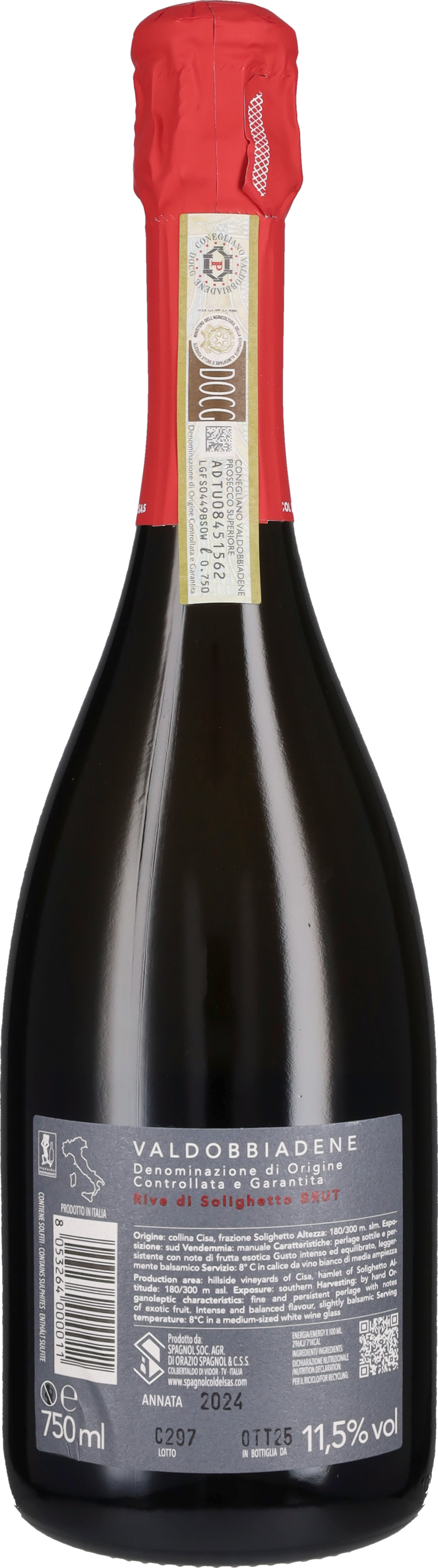
Prosecco di Valdobbiadene Superiore Brut 'Rive di Solighetto' Col del Sas - SpagnolThe Prosecco di Valdobbiadene Superiore Brut ‘Rive di Solighetto’ is a Metodo Charmat sparkling wine of extraordinary pleasantness produced by the Col del Sas – Spagnol winery. Since the early 1900s, the Spagnol family has been dedicated to viticulture in the Valdobbiadene area, and today the estate boasts over 34 hectares of owned vineyards. Among these, two plots stand out in particular: the one in Solighetto di Pieve di Soligo, once owned by Count Marco Giulio Balbi Valier, one of the pioneers of Prosecco, and the one in Col de Sas, a symbol of the Spagnol family's history. Col de Sas – Spagnol Prosecco di Valdobbiadene Superiore ‘Rive di Solighetto’ Brut is produced exclusively with Glera grapes grown on the Cisa hill, in the Solighetto fraction, within the municipality of Pieve di Soligo. The rows are south-facing and are located between 180 and 300 meters above sea level. After harvest, the grapes are vinified in white in stainless steel tanks, with at least 3 months of maturation on the fine lees, while the subsequent sparkling is carried out in autoclave according to the Charmat or Martinotti Method and is accompanied by an additional 3 months of aging before bottling, which takes place under isobaric conditions to preserve the wine's effervescence.sparkling is carried out in autoclave according to the Charmat or Martinotti Method and is accompanied by an additional 3 months of aging before bottling, which takes place under isobaric conditions to preserve the wine's effervescence. The ‘Rive di Solighetto’ Prosecco di Valdobbiadene Superiore Brut Col de Sas – Spagnol has a straw yellow color with fine and persistent bubbles. On the nose, it highlights fragrant notes of ripe and exotic fruit that blend with pleasant floral and balsamic nuances. Intense and balanced tasting, fresh and creamy, with a beautiful savory-mineral vein. This is a fine Prosecco resulting from a selection of the most vocated positions of the Cisa hill in Solighetto, capable of expressing the full essence of this territory.14,00 £*Shipping: 48,00 £Secure redirect to the provider
-
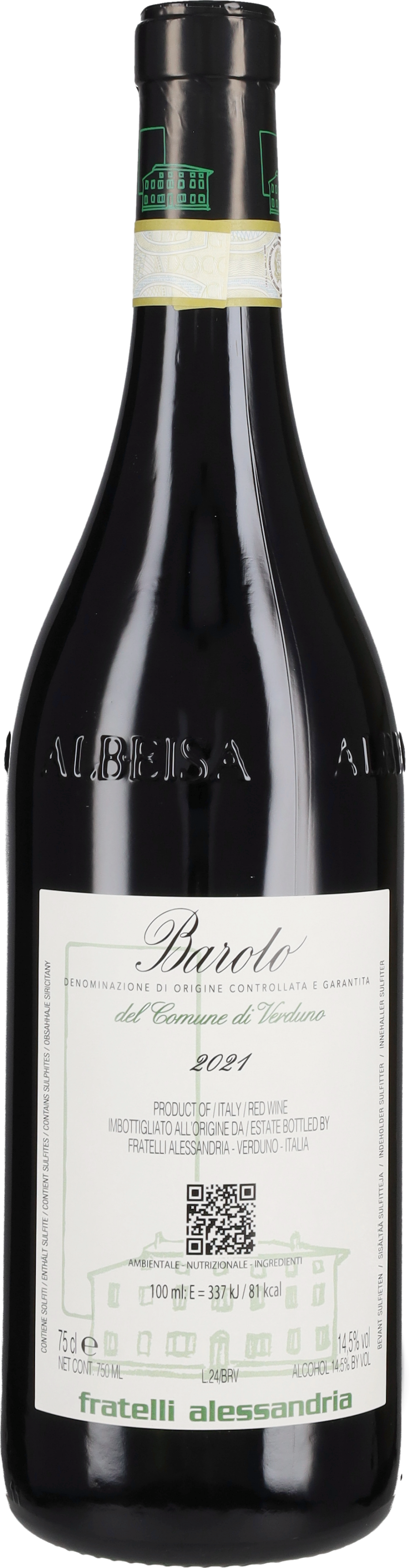
Barolo del Comune di Verduno Fratelli Alessandria 2021The Barolo Fratelli Alessandria represents the wine of tradition. Even today it is produced as it once was, with grapes from various vineyards, in order to achieve the right expressive balance each year. It is a Barolo that stands out especially for the refinement of its aromas and perfect expressive harmony. On the nose, it offers floral scents, small red berry fruits, toasted nuances, and a slight woodiness. The sip is intense, with elegant, persistent aromas and a long finish of pleasant freshness. The Barolo wine Fratelli Alessandria is the result of the experience and the oldest customs of the Langhe land. Far from the logic of Burgundy, of bottling each parcel separately to enhance the differences, in the land of Barolo, it was preferred to blend grapes from different vineyards with the aim of creating a single wine of greater harmony and more consistent over time. To produce Barolo, the Fratelli Alessandria estate uses Nebbiolo grapes harvested from the vineyards of Gramolere, in the municipality of Monforte d’Alba, Pisapola, Riva Rocca, Campasso, Roccheof the Olmo and Boscatto located in the municipality of Verduno. The vines have an average age of about 25 years and are trained in Guyot, with a density of about 4500 vines per hectare, on medium-textured soils of calcareous and clayey origin. Manual harvesting takes place in October. The fermentation is spontaneous using indigenous yeasts and takes place in stainless steel tanks at a temperature of 28-30 °C, lasting approximately 12-15 days. The wine matures for 36 months in French and Slavonian oak barrels of 20-40 hectoliters, for two months in steel, and finishes aging with at least 6 months in bottle. The Barolo produced by Fratelli Alessandria is the label that best represents the history and philosophy of the winery. A red of the past, dedicated to lovers of the great Piedmontese tradition. In the glass, it presents a beautiful ruby red, with slight nuances tending towards garnet. The olfactory profile is of particular finesse with delicate scents of violet, aromas of small red berry fruits, balsamic notes, slightlytoasted and slight memories of noble woods. On the palate, it has a good structure, an elegant tannic texture well integrated into the body of the wine, persistent and complex aromas, and a harmonious finish of balanced and pleasant freshness.45,00 £*Shipping: 48,00 £Secure redirect to the provider
-
Does anyone know the book Anne ici Selima là-bas?
Yes, "Anne ici Selima là-bas" is a well-known book written by Moroccan author Leila Slimani. The book tells the story of a young girl named Anne who is struggling to find her place in the world as she navigates her identity as a French-Moroccan. The novel has received critical acclaim and has been widely discussed in literary circles. It has been translated into several languages and has gained a global readership. **
-
After Al-Fatiha, does Sura Al-Kawthar come or Sura Al-Ikhlas?
After Al-Fatiha, Sura Al-Ikhlas comes before Sura Al-Kawthar in the order of the Quran. Sura Al-Ikhlas is the 112th chapter of the Quran, while Sura Al-Kawthar is the 108th chapter. Therefore, Sura Al-Ikhlas is recited before Sura Al-Kawthar in the sequence of the Quranic chapters. **
-
When do we use in Italian al, allo, all', alla, ai, agli, alle and del, dello, dell', della, dei, degli, delle?
In Italian, "al, allo, all', alla, ai, agli, alle" are used to indicate a combination of the preposition "a" (to, at) and the definite article "il, lo, l', la, i, gli, le" to express the contraction of the two words. These contractions are used when referring to specific places or locations. For example, "al mare" (at the sea), "alla stazione" (at the station). On the other hand, "del, dello, dell', della, dei, degli, delle" are used to indicate a combination of the preposition "di" (of, from) and the definite article "il, lo, l', la, i, gli, le" to express the contraction of the two words. These contractions are used when referring to possession or origin. For example, "del libro" (of the book), "della casa" (of the house). **
-
What does 'Rucke di guck, Rucke di guck, Blut ist im Schuh' mean?
"Rucke di guck, Rucke di guck, Blut ist im Schuh" is a German nursery rhyme that translates to "Rock-a-bye baby, blood is in the shoe" in English. The rhyme is a traditional lullaby that tells the story of a baby being rocked to sleep while blood is found in their shoe, which is a metaphor for the baby being cared for and protected. The rhyme is meant to soothe and comfort children as they drift off to sleep. **
What is Monaco di Baviera?
Monaco di Baviera is the Italian name for the city of Munich, the capital of the German state of Bavaria. It is known for its rich history, beautiful architecture, and vibrant cultural scene. Monaco di Baviera is also famous for its annual Oktoberfest celebration, which is the world's largest beer festival. The city is a popular tourist destination, offering visitors a mix of traditional Bavarian culture and modern urban attractions. **
How did Lady Di die?
Lady Diana, Princess of Wales, died in a car crash on August 31, 1997, in Paris, France. The car she was traveling in crashed in the Pont de l'Alma tunnel while being pursued by paparazzi. The crash resulted in her tragic death, along with her companion Dodi Fayed and their driver Henri Paul. The exact circumstances surrounding the crash have been the subject of much speculation and controversy. **
Top-Angebote
Products related to Al-di-là-del:
-
Insoglio del Cinghiale Campo di Sasso - Tenuta di Biserno 2024The Tuscan wine Insoglio del Cinghiale Campo di Sasso is the cornerstone of the entire production carried out by Tenuta di Biserno, a company founded in 2001 by Marquis Lodovico Antinori, eager to invest in the terroir of the Alta Maremma. A juicy and mature label, originating from a blend of Syrah, Cabernet Franc, Merlot and Petit Verdot, skilfully assembled to offer a balanced and high-quality sip, particularly fresh on the palate. The tannins are also striking, finely polished and round.This Insoglio del Cinghiale Campo di Sasso is made from a blend of only international grape varieties, which over the last few decades have proven to be perfectly suited to the terroir of the Tuscan Maremma. Alongside 30% Syrah, there is also Cabernet Franc, Merlot and Petit Verdot, varieties that are grown by Tenuta di Biserno using the spurred cordon system. The harvest takes place between the first week of September and the second week of October. After soft pressing of the grapes, the must ferments in steel at a controlled temperature for a period of 14-21 days. This is followed by ageing for 8 months in both new barriques and steel vats.The red Insoglio del Cinghiale Campo di Sasso produced by the Tenuta di Biserno winery has an intense colour, reminiscent of ruby. The nose is rich, with notes of small red fruits alternating with spicy sensations and hints of aromatic herbs; the finish has a delicate aroma that veers towards balsamic. On the palate, it is medium-bodied and balanced, with a striking, refreshing flavour. The flagship wine of the entire range produced in Bibbona, it is perfect for pairing with succulent game dishes.21,00 £*Shipping: 48,00 £Secure redirect to the provider
-
Insoglio del Cinghiale Campo di Sasso - Tenuta di Biserno 2024 - 37.5clThe Tuscan wine Insoglio del Cinghiale Campo di Sasso is the cornerstone of the entire production of Tenuta di Biserno, founded in 2001 by Marquis Lodovico Antinori, who was eager to invest in the terroir of the Upper Maremma. A juicy, ripe label, which originates from a blend of Syrah, Cabernet Franc, Merlot and Petit Verdot, skilfully blended to give a balanced and quality sip, particularly fresh on the palate. The tannins are also striking, finely polished and rounded.This Insoglio del Cinghiale Campo di Sasso is made from a blend of international grape varieties only, varieties which over the last few decades have proved to be perfectly suited to the terroir of the Tuscan Maremma. In addition to the 30% Syrah, there is also Cabernet Franc, Merlot and Petit Verdot, varieties grown by Tenuta di Biserno using the spurred cordon system. Harvesting takes place between the first week of September and the second week of October. After a gentle pressing of the grapes, the must ferments in steel tanks at a controlled temperature for a period of 14 to 21 days. It is then matured for 8 months in new barrels and steel vats.The red wine Insoglio del Cinghiale Campo di Sasso, produced by the Tenuta di Biserno winery, has an intense ruby-red colour. The nose is full-bodied, with notes of red berries alternating with spices and hints of aromatic herbs; on the finish, the aroma is delicate, tending towards balsamic. On the palate, it is medium-bodied and balanced, with an impressive mouthfeel and an excellent vein that refreshes the drink. The best wine in the entire Bibbona range, perfect with succulent game dishes.13,00 £*Shipping: 48,00 £Secure redirect to the provider
-
Rosso di Montepulciano Fattoria del Cerro 2024The Rosso di Montepulciano from Tenute del Cerro is a fragrant and fresh wine that expresses all the fruity richness of the Prugnolo Gentile grape. It is the youngest and pleasantly immediate version of the wines produced in the wonderful area of Montepulciano. On the hills surrounding the historic village, the vineyards produce grapes rich in scents and aromas, which we find with extreme varietal fidelity in the glass. A sip of red fruit, cherry, and light spicy nuances. It is a perfect wine to bring to the table to accompany the flavorful first courses of traditional Tuscan cuisine. The Rosso di Montepulciano is produced in one of the numerous estates managed by Tenute del Cerro, an important player in Italian wine, which operates mainly in Tuscany and Umbria. The wines of Montepulciano are produced at Fattoria del Cero, which along with La Poderina in Montalcino, Monterufoli in Chianti, Montecorona between Gubbio, and Colpetrone in Montefalco, constitutes a mosaic of vocated territories, allowing for the cultivation of each grape variety in the historically most vocated area, so that highlight its peculiar characteristics. The wines of Fattoria del Cerro are the result of careful work in the vineyards of the Montepulciano area, followed by a winemaking process carried out with very meticulous protocols. This way, a label is born that manages to authentically express the character of the grapes. The Rosso di Montepulciano from Cerro expresses the truest and sincerest face of Prugnolo Gentile, in its most fragrant and typically varietal version. At the end of the harvest, fermentation takes place in temperature-controlled stainless steel tanks, with skin maceration. The wine presents itself in the glass with a ruby red color and youthful violet hues. On the nose, it expresses a bouquet characterized by delicate scents of violet, aromas of ripe cherry, small red berry fruits, and nuances of aromatic herbs from the Mediterranean scrub. On the palate, it is medium-bodied, with a light tannic texture, a pleasantly juicy and fruity sip. The finish is fresh and has good taste persistence.9,00 £*Shipping: 48,00 £Secure redirect to the provider
-
When do I use "del" and when do I use "al"?
"Del" is a contraction of "de" (of, from) and "el" (the), and is used to indicate possession or relationship between two things. For example, "el libro del estudiante" (the student's book). On the other hand, "al" is a contraction of "a" (to, at) and "el" (the), and is used to indicate movement or direction towards a specific place or time. For example, "Voy al supermercado" (I'm going to the supermarket). **
-
What is the name of this mobile phone song Ai di di di di di di dai? I think it's a Russian song.
The song you are referring to is "Ai, Ai, Ai" by the Russian artist Polina Gagarina. It is a popular Russian pop song that gained international recognition. The catchy melody and upbeat rhythm have made it a favorite for mobile phone ringtones and music downloads. If you enjoy this song, you may also like other hits by Polina Gagarina. **
-
Does anyone know the book Anne ici Selima là-bas?
Yes, "Anne ici Selima là-bas" is a well-known book written by Moroccan author Leila Slimani. The book tells the story of a young girl named Anne who is struggling to find her place in the world as she navigates her identity as a French-Moroccan. The novel has received critical acclaim and has been widely discussed in literary circles. It has been translated into several languages and has gained a global readership. **
-
After Al-Fatiha, does Sura Al-Kawthar come or Sura Al-Ikhlas?
After Al-Fatiha, Sura Al-Ikhlas comes before Sura Al-Kawthar in the order of the Quran. Sura Al-Ikhlas is the 112th chapter of the Quran, while Sura Al-Kawthar is the 108th chapter. Therefore, Sura Al-Ikhlas is recited before Sura Al-Kawthar in the sequence of the Quranic chapters. **
Similar search terms for Al-di-là-del
-
Prosecco di Valdobbiadene Superiore Brut 'Rive di Solighetto' Col del Sas - SpagnolThe Prosecco di Valdobbiadene Superiore Brut ‘Rive di Solighetto’ is a Metodo Charmat sparkling wine of extraordinary pleasantness produced by the Col del Sas – Spagnol winery. Since the early 1900s, the Spagnol family has been dedicated to viticulture in the Valdobbiadene area, and today the estate boasts over 34 hectares of owned vineyards. Among these, two plots stand out in particular: the one in Solighetto di Pieve di Soligo, once owned by Count Marco Giulio Balbi Valier, one of the pioneers of Prosecco, and the one in Col de Sas, a symbol of the Spagnol family's history. Col de Sas – Spagnol Prosecco di Valdobbiadene Superiore ‘Rive di Solighetto’ Brut is produced exclusively with Glera grapes grown on the Cisa hill, in the Solighetto fraction, within the municipality of Pieve di Soligo. The rows are south-facing and are located between 180 and 300 meters above sea level. After harvest, the grapes are vinified in white in stainless steel tanks, with at least 3 months of maturation on the fine lees, while the subsequent sparkling is carried out in autoclave according to the Charmat or Martinotti Method and is accompanied by an additional 3 months of aging before bottling, which takes place under isobaric conditions to preserve the wine's effervescence.sparkling is carried out in autoclave according to the Charmat or Martinotti Method and is accompanied by an additional 3 months of aging before bottling, which takes place under isobaric conditions to preserve the wine's effervescence. The ‘Rive di Solighetto’ Prosecco di Valdobbiadene Superiore Brut Col de Sas – Spagnol has a straw yellow color with fine and persistent bubbles. On the nose, it highlights fragrant notes of ripe and exotic fruit that blend with pleasant floral and balsamic nuances. Intense and balanced tasting, fresh and creamy, with a beautiful savory-mineral vein. This is a fine Prosecco resulting from a selection of the most vocated positions of the Cisa hill in Solighetto, capable of expressing the full essence of this territory.14,00 £*Shipping: 48,00 £Secure redirect to the provider
-
Barolo del Comune di Verduno Fratelli Alessandria 2021The Barolo Fratelli Alessandria represents the wine of tradition. Even today it is produced as it once was, with grapes from various vineyards, in order to achieve the right expressive balance each year. It is a Barolo that stands out especially for the refinement of its aromas and perfect expressive harmony. On the nose, it offers floral scents, small red berry fruits, toasted nuances, and a slight woodiness. The sip is intense, with elegant, persistent aromas and a long finish of pleasant freshness. The Barolo wine Fratelli Alessandria is the result of the experience and the oldest customs of the Langhe land. Far from the logic of Burgundy, of bottling each parcel separately to enhance the differences, in the land of Barolo, it was preferred to blend grapes from different vineyards with the aim of creating a single wine of greater harmony and more consistent over time. To produce Barolo, the Fratelli Alessandria estate uses Nebbiolo grapes harvested from the vineyards of Gramolere, in the municipality of Monforte d’Alba, Pisapola, Riva Rocca, Campasso, Roccheof the Olmo and Boscatto located in the municipality of Verduno. The vines have an average age of about 25 years and are trained in Guyot, with a density of about 4500 vines per hectare, on medium-textured soils of calcareous and clayey origin. Manual harvesting takes place in October. The fermentation is spontaneous using indigenous yeasts and takes place in stainless steel tanks at a temperature of 28-30 °C, lasting approximately 12-15 days. The wine matures for 36 months in French and Slavonian oak barrels of 20-40 hectoliters, for two months in steel, and finishes aging with at least 6 months in bottle. The Barolo produced by Fratelli Alessandria is the label that best represents the history and philosophy of the winery. A red of the past, dedicated to lovers of the great Piedmontese tradition. In the glass, it presents a beautiful ruby red, with slight nuances tending towards garnet. The olfactory profile is of particular finesse with delicate scents of violet, aromas of small red berry fruits, balsamic notes, slightlytoasted and slight memories of noble woods. On the palate, it has a good structure, an elegant tannic texture well integrated into the body of the wine, persistent and complex aromas, and a harmonious finish of balanced and pleasant freshness.45,00 £*Shipping: 48,00 £Secure redirect to the provider
-
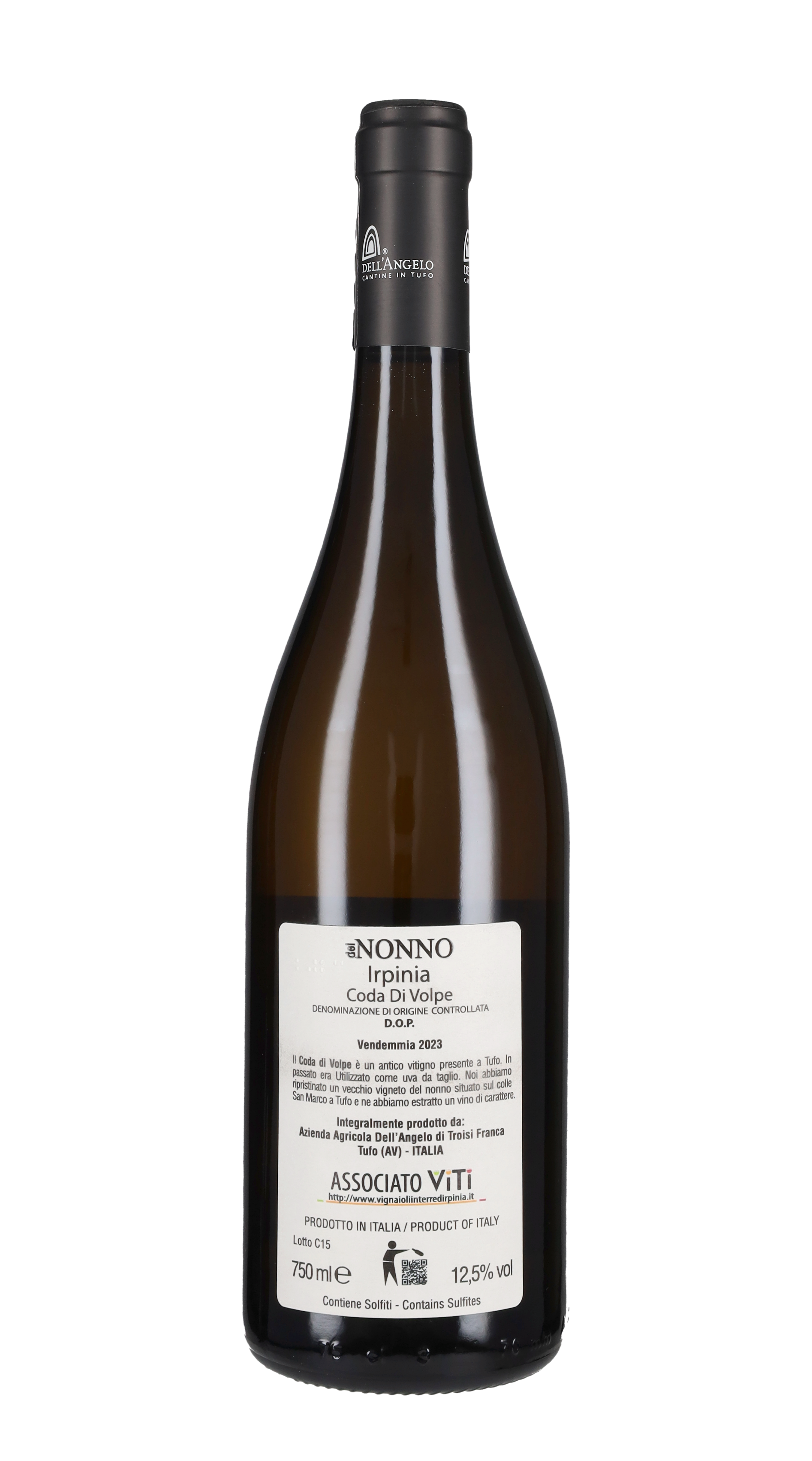
Coda di Volpe 'Del Nonno' Cantine dell'Angelo 2024The Coda di Volpe ‘Del Nonno’ from Cantine dell’Angelo is configured as a typically mineral interpretation of the Irpinia territory, particularly the area of Tufo. In fact, Angelo Muto, the owner of Cantine dell’Angelo, operates within the territory of Tufo, in the heart of Irpinia, in an area highly suited for the cultivation of the Greco grape, which is no coincidence the varietal symbol of the winery. This is accompanied by the Coda di Volpe, another native Campanian grape, entirely used by Angelo for the production of the label ‘Del Nonno’, the latter name deriving from the homonymous old vineyard from which the grapes come.The Coda di Volpe Cantine dell’Angelo ‘Del Nonno’ is made from only Coda di Volpe grapes coming from a old vineyard located on the San Marco hill in Tufo, cultivated using low environmental impact agronomic practices. Following the harvest, which is carried out entirely by hand, the bunches undergo a direct soft pressing, followed by spontaneous alcoholic fermentation in stainless steel tanks entrusted to only indigenous yeasts. The subsequent maturation phase also takes place in steel, containers in which the wine rests for a total period of about 10 months, of which 6 spent on the fine lees.‘Del Nonno’ Coda di Volpe from Cantine dell’Angelo has an intense straw yellow hue. The aromatic bouquet is described by fragrant floral hints of chamomile that combine with aromas of bergamot and sage, as well as intriguing mineral notes of sulfur. Agile and tasty tasting, deep and refreshing, endowed with a intensely savory finish. By virtue of its organoleptic characteristics, this white wine represents a winning pairing with seafood cuisine, particularly with mixed fried dishes, seafood risottos, or grilled fish.19,00 £*Shipping: 48,00 £Secure redirect to the provider
-
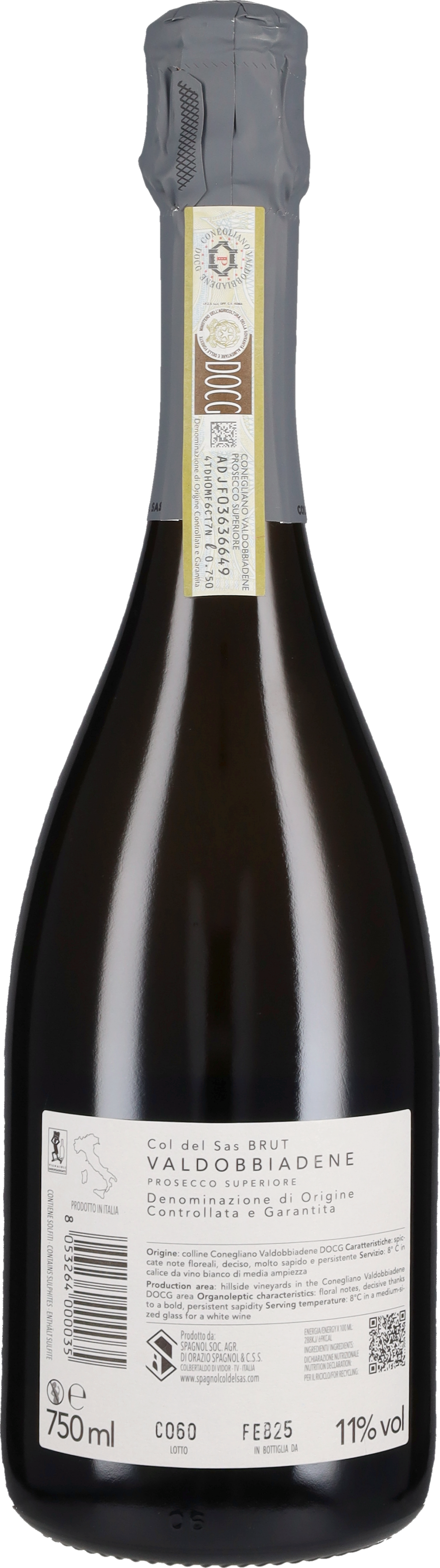
Prosecco di Valdobbiadene Superiore Brut Col del Sas - SpagnolThe Prosecco Superiore di Valdobbiadene Brut Col del Sas represents the pinnacle of the quality pyramid of Prosecco. It comes, in fact, from the classic area of Valdobbiadene, which is historically the most suited for the cultivation of Glera grapes. It is a sparkling wine made using the Martinotti or Charmat method, appreciated for its fragrant aromatic intensity and pleasant freshness. The secret to its success lies precisely in this expressive simplicity, direct and immediate, which immediately conquers the palate and asks for another sip. The Valdobbiadene Brut Prosecco Superiore is produced by the Spagnol family, who own the prized vineyard Col del Sas in the Valdobbiadene area, the first nucleus of the company. Today, the estate includes several plots in various areas of the denomination: Solighetto, Farra di Soligo, San Pietro di Felletto, Vidor, and Collalto. The steep slopes near the Prealps, the beautiful sunny exposures, the cool climate, and the predominantly calcareous-clay soils create a perfect habitat for cultivating high-quality Glera grapes.The Col de Sas label is produced with a selection of grapes from the best vineyards. After gentle pressing, the free-run must is sent for fermentation in stainless steel tanks at controlled temperature. The base wine rests for a few months in steel before being transferred to an autoclave for the sparkling process and second fermentation, according to the Martinotti Method, lasting at least 60 days. The Prosecco Brut Col del Sas takes its name from the historic vineyard of the Spagnol family. It is an elegant and fresh Prosecco, which, thanks to a low dosage, enhances the primary aromas of the Glera grape and its aromatic richness. In the glass, it presents a pale straw yellow color, with slight greenish reflections. The perlage is fine and persistent. On the nose, it expresses a bouquet of delicate floral notes, accompanied by fragrant aromas of pear and white fruit. The sip is lively and savory, with a juicy mid-palate and a pleasantly refreshing finish.14,00 £*Shipping: 48,00 £Secure redirect to the provider
-
When do we use in Italian al, allo, all', alla, ai, agli, alle and del, dello, dell', della, dei, degli, delle?
In Italian, "al, allo, all', alla, ai, agli, alle" are used to indicate a combination of the preposition "a" (to, at) and the definite article "il, lo, l', la, i, gli, le" to express the contraction of the two words. These contractions are used when referring to specific places or locations. For example, "al mare" (at the sea), "alla stazione" (at the station). On the other hand, "del, dello, dell', della, dei, degli, delle" are used to indicate a combination of the preposition "di" (of, from) and the definite article "il, lo, l', la, i, gli, le" to express the contraction of the two words. These contractions are used when referring to possession or origin. For example, "del libro" (of the book), "della casa" (of the house). **
-
What does 'Rucke di guck, Rucke di guck, Blut ist im Schuh' mean?
"Rucke di guck, Rucke di guck, Blut ist im Schuh" is a German nursery rhyme that translates to "Rock-a-bye baby, blood is in the shoe" in English. The rhyme is a traditional lullaby that tells the story of a baby being rocked to sleep while blood is found in their shoe, which is a metaphor for the baby being cared for and protected. The rhyme is meant to soothe and comfort children as they drift off to sleep. **
-
What is Monaco di Baviera?
Monaco di Baviera is the Italian name for the city of Munich, the capital of the German state of Bavaria. It is known for its rich history, beautiful architecture, and vibrant cultural scene. Monaco di Baviera is also famous for its annual Oktoberfest celebration, which is the world's largest beer festival. The city is a popular tourist destination, offering visitors a mix of traditional Bavarian culture and modern urban attractions. **
-
How did Lady Di die?
Lady Diana, Princess of Wales, died in a car crash on August 31, 1997, in Paris, France. The car she was traveling in crashed in the Pont de l'Alma tunnel while being pursued by paparazzi. The crash resulted in her tragic death, along with her companion Dodi Fayed and their driver Henri Paul. The exact circumstances surrounding the crash have been the subject of much speculation and controversy. **
* All prices are inclusive of VAT and, if applicable, plus shipping costs. The offer information is based on the details provided by the respective shop and is updated through automated processes. Real-time updates do not occur, so deviations can occur in individual cases. ** Note: Parts of this content were created by AI.